erick@spiewakgroup.com
0750-3668626
+86-13428282793


Door security has become an important consideration in modern architectural projects. From residential buildings and hotels to offices, schools, and commercial facilities, the choice between mechanical locks and electronic locks directly affects access control, maintenance requirements, installation cost, and long-term reliability.
Although both systems are designed to protect doors, their working principles are completely different. Mechanical locks rely on physical components such as cylinders, keys, latches, and deadbolts, while electronic locks use digital technologies including passwords, cards, biometrics, or smart control systems.
Choosing the right lock system requires evaluating security requirements, building usage, maintenance conditions, and project budget.
As a professional architectural hardware manufacturer, Wingstec provides complete door hardware solutions including mechanical locks, smart locks, lever locks, knob locks, mortise locks, handles, and related accessories. With a 4,000㎡ production area, more than 10 production lines, nearly 150 skilled workers, and over 3,000 customizable solutions, Wingstec supports customized architectural hardware projects worldwide. (Wingstec)
The main difference between mechanical and electronic locks is the way access is controlled.
A mechanical lock uses traditional physical structures. When a key turns the cylinder, the internal mechanism releases the latch or deadbolt.
An electronic lock uses electronic components to verify user identity before unlocking the door.
| Comparison | Mechanical Lock | Electronic Lock |
|---|---|---|
| Access method | Key operation | Digital verification |
| Power requirement | No power needed | Requires electricity or battery |
| Installation | Simple | More complex |
| Maintenance | Low | Higher |
| Security management | Traditional | Advanced access control |
| Application | Residential and commercial | Smart buildings and controlled access areas |
Mechanical locks have been used for decades because of their reliability and simple structure.
The operating process includes:
User inserts and turns the key
Cylinder rotates
Internal pins or components move
Latch or deadbolt retracts
Door opens
Common mechanical lock products include:
Knob locks
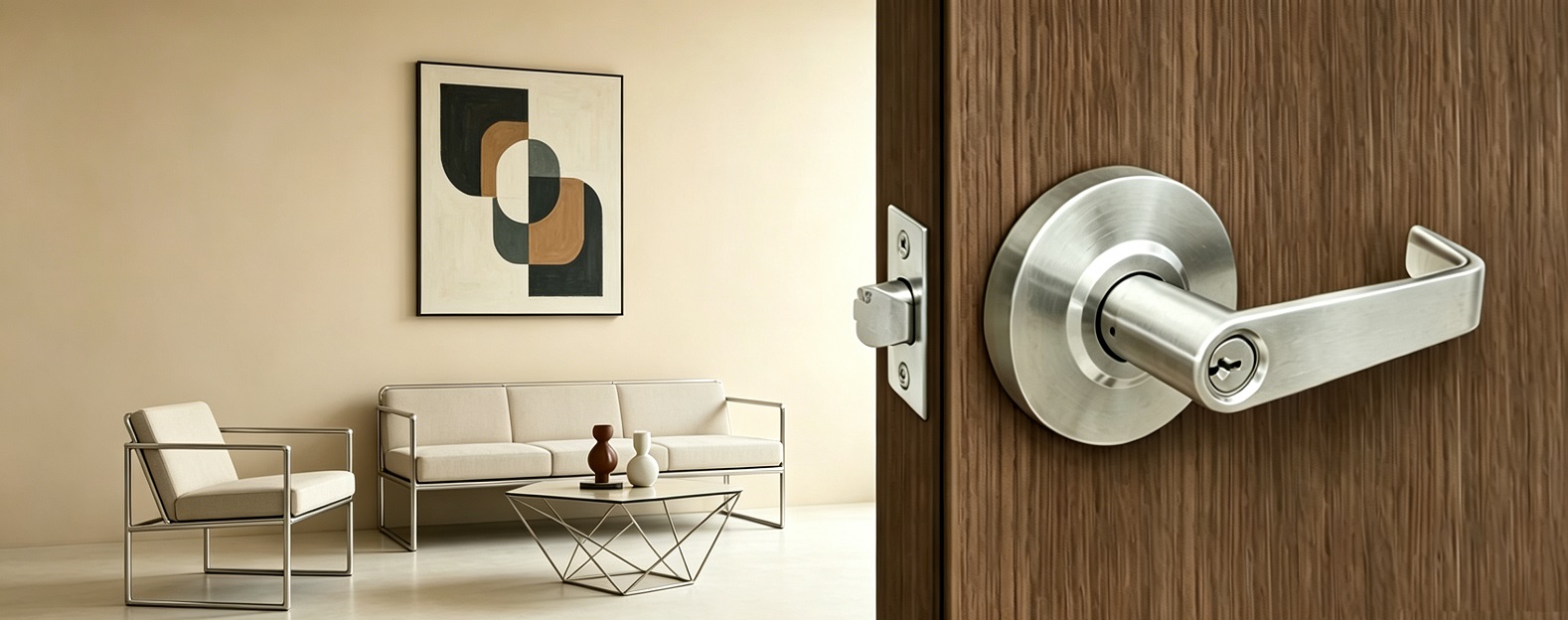
Lever locks
Mortise locks
Deadbolt locks
Wingstec offers different mechanical door lock solutions, including lever lock sets, knob lock systems, mortise locks, and cylinder products designed for residential and commercial applications. (Wingstec)
Mechanical locks do not depend on electricity or network systems, making them reliable during power failures.
Their simple structure reduces maintenance needs.
Typical maintenance includes:
Cleaning components
Lubricating moving parts
Replacing worn cylinders
Mechanical locks usually have lower purchase and installation costs, making them suitable for large-scale projects requiring stable and economical solutions.
Electronic locks use digital systems to control access.
The operation process usually includes:
User provides authentication information
System verifies identity
Electronic mechanism activates
Lock releases automatically
Common access methods include:
Password entry
RFID cards
Fingerprint recognition
Mobile applications
Remote management systems
Electronic locks allow administrators to:
Add or remove users
Track access records
Control permissions
This makes them suitable for:
Hotels
Smart offices
Apartment buildings
Commercial facilities
Users do not need traditional keys, improving daily convenience.
Electronic locks can connect with:
Building management systems
Smart home platforms
Security systems
Security depends on application requirements rather than technology alone.
| Security Factor | Mechanical Lock | Electronic Lock |
|---|---|---|
| Physical strength | Excellent | Good |
| Access control | Basic | Advanced |
| Key management | Manual | Digital |
| Audit records | Limited | Available |
| Emergency operation | Simple | Depends on system |
For traditional security requirements, mechanical locks provide stable protection. For buildings requiring centralized access management, electronic locks offer more control functions.
Door locks experience thousands of operating cycles during daily use.
| Factor | Mechanical Lock | Electronic Lock |
|---|---|---|
| Service life | Long | Long with proper maintenance |
| Moving parts | More mechanical parts | Mechanical and electronic parts |
| Maintenance frequency | Low | Medium |
| Environmental sensitivity | Lower | Higher |
Mechanical locks perform well in environments where simplicity and reliability are priorities.
Electronic locks require additional attention to:
Battery condition
Electronic components
Software systems
Connection stability
Material selection affects lock durability and appearance.
Common materials include:
Stainless steel
Brass
Zinc alloy
Aluminum alloy
| Material | Advantages |
|---|---|
| Stainless steel | Corrosion resistance and strength |
| Brass | Durability and premium appearance |
| Zinc alloy | Flexible design and finishing |
| Aluminum alloy | Lightweight structure |
For commercial Door Hardware, stainless steel and brass components are often preferred because they provide better resistance against daily wear.
A reliable lock manufacturer must control every production stage.
The manufacturing process usually includes:
Raw material inspection
Precision machining
Component forming
Surface treatment
Assembly
Function testing
Final quality inspection
Mechanical locks require accurate machining because cylinder, latch, and internal components must work together smoothly.
Electronic locks require additional quality control for:
Circuit boards
Sensors
Power systems
Communication modules
Professional lock production requires strict inspection procedures.
| Inspection Point | Purpose |
|---|---|
| Material inspection | Confirm raw material quality |
| Dimension testing | Ensure component accuracy |
| Lock operation testing | Verify smooth function |
| Cycle testing | Check long-term durability |
| Surface inspection | Maintain appearance quality |
Wingstec focuses on quality management throughout production to maintain consistent performance across different architectural hardware applications. (Wingstec)
The total project cost includes purchase price, installation, maintenance, and replacement requirements.
| Cost Factor | Mechanical Lock | Electronic Lock |
|---|---|---|
| Initial investment | Lower | Higher |
| Installation | Easier | More complex |
| Maintenance | Lower | Higher |
| Management cost | Higher for large systems | Lower for centralized control |
| Long-term value | Excellent for standard use | Excellent for smart applications |
Mechanical locks are often preferred for cost-effective projects, while electronic locks provide stronger value when access management is important.
Lock systems require precise engineering and stable production control.
Working directly with a manufacturer provides advantages including:
Product customization
Material selection support
Quality control transparency
Stable production capacity
Technical assistance
For large architectural projects, supplier capability directly affects:
Product consistency
Delivery reliability
After-sales support
Wingstec provides OEM and ODM architectural hardware solutions, supporting customized designs, product development, and project-based supply requirements. (Wingstec)
Customized lock development usually includes:
Project requirement analysis
Product structure confirmation
Material selection
Prototype production
Sample testing
Mass production
Quality inspection
Customization options include:
Lock structure
Handle matching
Surface finish
Packaging design
Logo customization
Before selecting a lock system, consider:
| Evaluation Item | Key Question |
|---|---|
| Building type | Residential or commercial? |
| Security level | Standard or advanced control? |
| User volume | Few users or many users? |
| Maintenance plan | Simple or smart management? |
| Material requirement | Stainless steel or other materials? |
| Customization | OEM requirements needed? |
For international architectural hardware projects, suppliers should provide:
Product specifications
Quality documentation
Installation instructions
Packaging standards
Technical support
Reliable production systems help ensure consistent performance across different markets.
A mechanical lock is suitable for:
Residential buildings
Standard commercial doors
Cost-sensitive projects
Applications requiring simple maintenance
An electronic lock is suitable for:
Smart buildings
Hotels
Offices
Projects requiring access management
The best choice depends on security goals, building function, and management requirements.
For architectural projects requiring reliable door security solutions, Wingstec provides professional hardware manufacturing capabilities with OEM/ODM support, strict quality control, and customized production services. Through advanced manufacturing and stable supply capability, Wingstec helps global projects achieve secure and durable door hardware solutions.