erick@spiewakgroup.com
0750-3668626
+86-13428282793


Door Hardware selection plays an important role in modern architectural projects. Although sliding doors and hinged doors both provide access solutions, their handle systems are designed for different structures, operating methods, and application environments.
A sliding door handle is designed for doors that move horizontally along a track, while a hinged door handle is designed for traditional swing doors that rotate around hinges. Understanding their differences helps architects, contractors, and project developers choose the right hardware solution for performance, durability, and design requirements.
As a professional Architectural Hardware manufacturer, Wingstec provides door hardware solutions including handles, locks, hinges, glass hardware, and customized architectural accessories. With integrated manufacturing capability, OEM/ODM support, and export-oriented quality management, Wingstec develops hardware solutions for residential, commercial, and architectural projects. (Wingstec)
The biggest difference between sliding door handles and hinged door handles is the door movement structure.
A sliding door handle works with doors that move horizontally. The handle design usually focuses on easy gripping, space saving, and smooth operation.
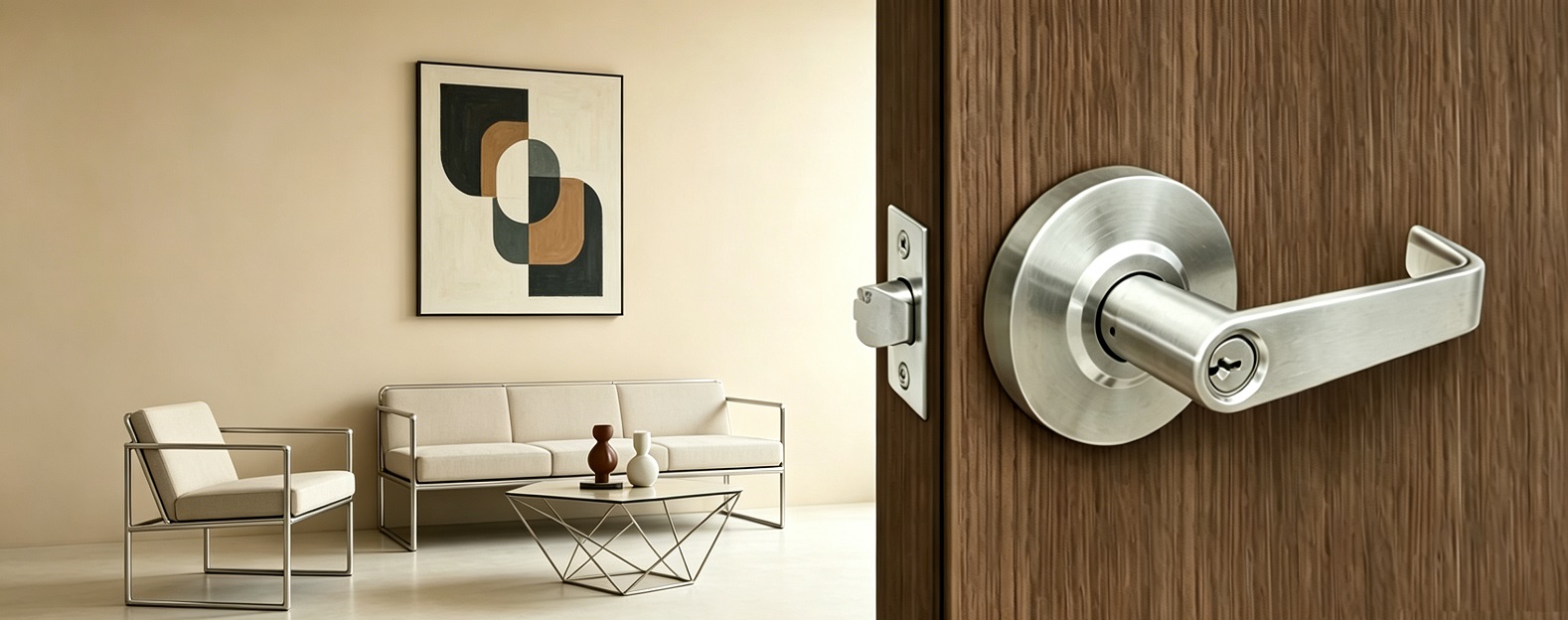
A hinged door handle works with doors that rotate around hinges. The handle operates the latch mechanism to open and close the door.
| Comparison | Sliding Door Handle | Hinged Door Handle |
|---|---|---|
| Door movement | Horizontal sliding | Swing opening |
| Installation method | Mounted on sliding door system | Mounted with latch and hinges |
| Space requirement | Lower | Requires swing clearance |
| Main advantage | Space efficiency | Wide application range |
| Common applications | Glass doors, partitions, closets | Offices, hotels, residential doors |
Sliding door systems are widely used in modern buildings because they maximize available space and provide a clean appearance.
The operation process includes:
User grips the handle
Door moves along the track
Rollers or sliding mechanisms guide movement
Door reaches the open or closed position
Sliding doors do not require a large opening area, making them suitable for:
Apartments
Offices
Hotels
Glass partitions
Commercial interiors
This advantage is especially important in modern buildings where space utilization is a priority.
Sliding door handles are often designed with:
Minimalist shapes
Stainless steel finishes
Aluminum structures
Custom surface treatments
They can integrate well with glass doors and contemporary architectural styles.
A well-designed sliding door handle works together with:
Door rollers
Tracks
Door frames
Locking systems
The complete system determines long-term operating performance.
Hinged doors remain one of the most common door systems in residential and commercial buildings.
The operation process includes:
User presses or rotates the handle
Internal spindle activates the latch
Door rotates around hinges
Door opens or closes
Hinged door handles are commonly used in:
Office rooms
Hotel doors
Residential entrances
Commercial buildings
Public facilities
They can work with different systems including:
Mortise locks
Cylindrical locks
Privacy locks
Heavy-duty door systems
Because hinged door systems are widely used, replacement parts and maintenance solutions are easier to manage.
Different building environments require different hardware solutions.
| Application | Recommended Handle Type |
|---|---|
| Glass partition systems | Sliding door handle |
| Space-saving interiors | Sliding door handle |
| Office rooms | Hinged door handle |
| Hotel entrances | Hinged door handle |
| Residential doors | Hinged door handle |
| Modern open-plan spaces | Sliding door handle |
Material selection directly affects door handle service life.
Common materials include:
Stainless steel
Aluminum alloy
Zinc alloy
Brass
| Material | Advantages |
|---|---|
| Stainless steel | High strength and corrosion resistance |
| Aluminum alloy | Lightweight and flexible design |
| Zinc alloy | Good forming ability |
| Brass | Premium appearance |
For commercial projects, stainless steel is often preferred because it provides strong durability and resistance to daily wear.
A professional door hardware manufacturer needs strict control throughout production.
The typical manufacturing process includes:
Raw material inspection
Cutting and forming
CNC machining
Surface polishing
Surface finishing
Assembly
Functional testing
Packaging
For sliding door handles, dimensional accuracy is important because improper fitting can affect sliding performance.
For hinged door handles, spindle accuracy, latch compatibility, and mechanical strength are key quality factors.
Door hardware requires detailed inspection before delivery.
| Inspection Point | Purpose |
|---|---|
| Material inspection | Confirm material standards |
| Size measurement | Ensure installation accuracy |
| Surface inspection | Maintain appearance quality |
| Strength testing | Verify durability |
| Function testing | Ensure smooth operation |
Wingstec focuses on production control from material selection to final inspection to maintain stable product quality for architectural applications. (Wingstec)
Choosing door hardware should consider total project value rather than only product price.
| Cost Factor | Sliding Door Handle | Hinged Door Handle |
|---|---|---|
| Initial cost | Medium | Medium |
| Installation complexity | Medium | Lower |
| Space efficiency | Excellent | Moderate |
| Application flexibility | Medium | Excellent |
| Maintenance availability | Good | Excellent |
Sliding door handles can provide better value in space-limited projects, while hinged door handles provide broader application flexibility.
Architectural hardware projects often require customization, stable supply, and consistent quality.
Working directly with a manufacturer provides advantages such as:
Product customization
Material selection support
Surface finish options
Packaging solutions
Production control
Technical support
Wingstec specializes in architectural hardware manufacturing, including door hardware, window hardware, glass hardware, smart locks, hinges, and related products. The company supports OEM and ODM development, customized packaging, and project sourcing solutions. (Wingstec)
Customized door hardware development usually includes:
Requirement analysis
Design confirmation
Material selection
Prototype development
Sample approval
Mass production
Quality inspection
Customization options include:
Handle dimensions
Material type
Surface treatment
Logo marking
Packaging design
Before selecting door handles, consider:
| Evaluation Item | Key Question |
|---|---|
| Door type | Sliding or hinged system? |
| Usage environment | Residential or commercial? |
| Material requirement | Stainless steel or aluminum? |
| Design style | Modern or traditional? |
| Quantity | Standard supply or project volume? |
| Customization | OEM requirements needed? |
For international architectural hardware projects, suppliers should provide:
Product specifications
Quality documentation
Packaging standards
Installation information
Technical support
Reliable manufacturing systems help ensure consistent quality across different markets.
A sliding door handle is suitable for:
Space-saving projects
Glass door systems
Modern interior designs
Sliding partition applications
A hinged door handle is suitable for:
Offices
Hotels
Residential buildings
Commercial entrances
The better choice depends on door structure, application requirements, and project goals.
For modern architectural projects requiring customized and reliable hardware solutions, Wingstec provides professional manufacturing support with OEM/ODM capability, strict quality control, and complete architectural hardware solutions.