erick@spiewakgroup.com
0750-3668626
+86-13428282793


A door handle is a mechanical control device designed to operate a latch mechanism, allowing a door to open and close securely. Although it appears simple from the outside, its functionality relies on a precisely engineered internal system consisting of a spindle, return spring, latch bolt, and mounting assembly. The efficiency, durability, and safety of a door handle depend not only on its design but also on the quality of its manufacturing process.
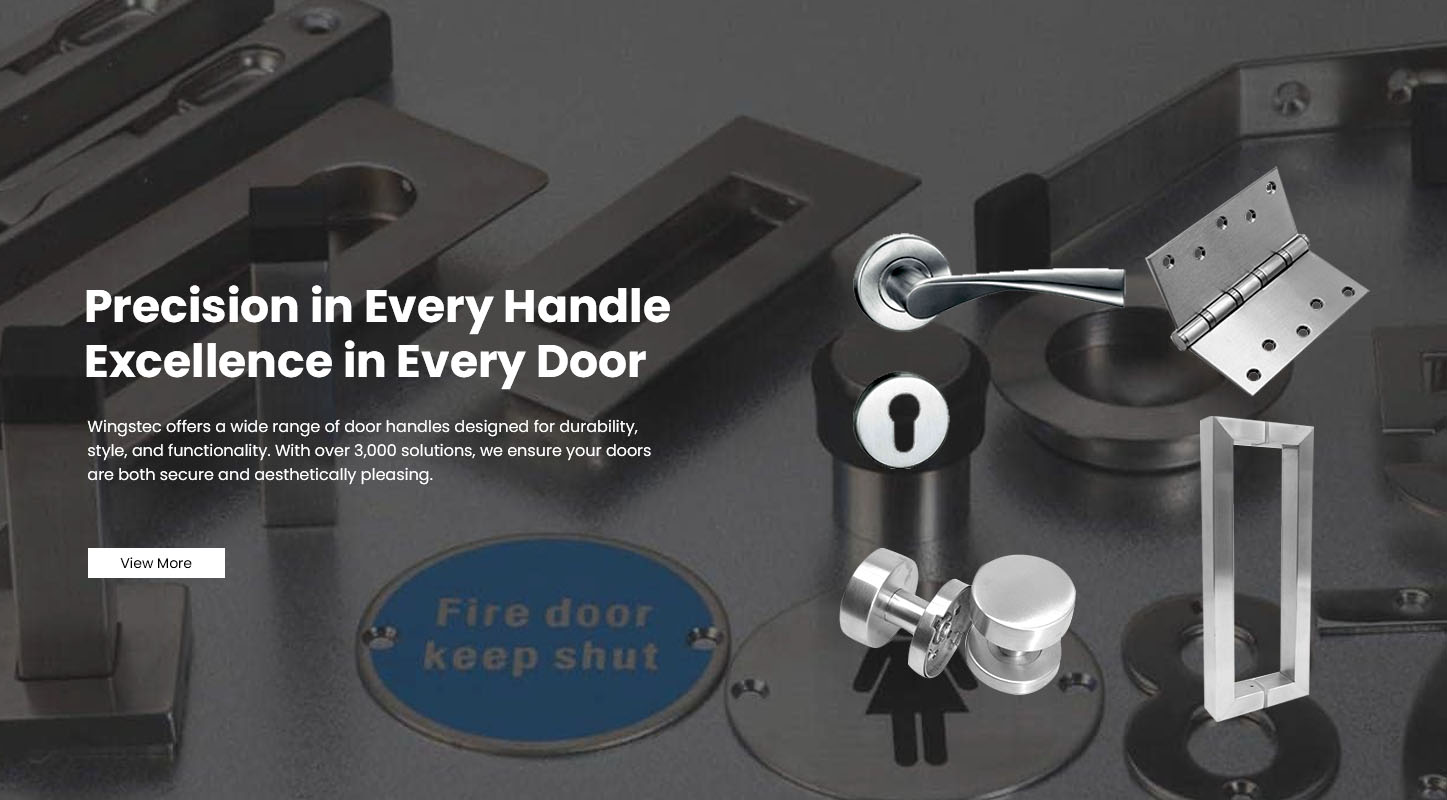
As a professional architectural hardware manufacturer, Wingstec produces lever handles, knob sets, lock bodies, hinges, and related accessories for residential and commercial projects. With integrated production control and OEM/ODM capabilities, we ensure structural reliability and export-grade compliance across global markets.
A standard door handle assembly typically includes:
This is the visible external component. When force is applied by hand, it rotates around a central axis.
The spindle is a square or round metal rod connecting the two handles on either side of the door. Rotation of the handle turns the spindle.
The latch bolt is spring-loaded and installed within the door edge. When the spindle rotates, it retracts the latch bolt into the door body.
The internal spring mechanism ensures the handle returns to its original horizontal position after release.
These secure the handle to the door surface and conceal fixing screws.
The coordination of these components allows controlled retraction and release of the latch, enabling smooth door operation.
User Applies Rotational Force
Turning the lever transfers torque to the spindle.
Spindle Rotates the Latch Cam
The cam inside the latch assembly converts rotational movement into linear motion.
Latch Bolt Retracts
The bolt compresses the internal spring and withdraws into the latch housing.
Door Opens
With the latch disengaged from the strike plate, the door can swing open.
Handle Released
The return spring resets the lever to its neutral position, and the latch bolt extends outward again.
This mechanical conversion of rotational force into linear retraction is the fundamental principle behind door handle operation.
The reliability of this system depends heavily on production precision. door handle manufacturing generally includes:
Die casting or forging to form the handle body
CNC machining for spindle and cam precision
Heat treatment for internal steel components
Surface finishing such as polishing, brushing, or electroplating
Assembly integration of springs and mechanical parts
Functional cycle testing
As a factory-based manufacturer, Wingstec controls each stage internally to ensure dimensional consistency and mechanical reliability across bulk production batches.
When sourcing Door Handles for projects:
Working with a Manufacturer Provides:
Direct control over spindle tolerance accuracy
Verified spring tension calibration
Customizable latch backset dimensions
Stable bulk supply capability
Engineering support during installation
Traders Typically Offer:
Limited visibility into internal mechanical design
Inconsistent dimensional tolerances between batches
Restricted customization capability
For project sourcing, especially in commercial or institutional settings, mechanical precision significantly affects long-term durability.
For projects requiring tailored designs or branding, a structured OEM/ODM workflow is critical:
Concept or drawing submission
Technical feasibility analysis
Prototype sample development
Mechanical performance testing
Finish approval
Bulk production scheduling
Export preparation and inspection
Customization may include spindle length adjustments, spring force optimization, or finish modifications depending on usage environment.
When procuring door handles in large quantities, buyers should confirm:
Door thickness compatibility range
Latch backset specifications
Mechanical cycle durability ratings
Corrosion resistance performance
Uniform finish consistency
Bulk projects require uniform mechanical performance across hundreds or thousands of installed units. Precision machining ensures smooth operation and prevents premature loosening.
Professional factories implement strict inspection protocols:
Dimensional tolerance verification
Spring tension testing
Spindle alignment inspection
Surface adhesion testing
Corrosion resistance evaluation
Functional cycle durability testing
These checkpoints guarantee that each door handle maintains smooth rotation and reliable latch engagement over extended use.
High-quality door handles commonly incorporate:
Stainless steel for corrosion resistance
Zinc alloy for structural casting precision
Brass components for wear resistance
Hardened steel springs for return mechanisms
Material selection directly influences lifespan, mechanical smoothness, and structural integrity.
For international supply, manufacturers must address:
Mechanical durability requirements of destination markets
Corrosion testing documentation
Safe packaging standards
Accurate export documentation
Factory-based exporters streamline compliance processes and reduce project risk.
A door handle works by converting rotational force into linear latch retraction through a precisely engineered spindle and cam system. While the external design appears simple, internal mechanical accuracy determines durability, smooth operation, and long-term reliability.
Behind this everyday hardware lies a structured manufacturing system involving material control, machining precision, surface finishing, and quality inspection. Partnering with a qualified door hardware manufacturer ensures stable bulk supply, customization flexibility, and mechanical performance consistency suitable for global projects.