erick@spiewakgroup.com
0750-3668626
+86-13428282793


Door Hardware may appear similar between residential and commercial buildings, but the performance requirements are often completely different. A handle, lock, hinge, or door closer used in a family home usually focuses on comfort, appearance, and daily convenience, while commercial door hardware must support higher traffic frequency, stronger durability, safety requirements, and long-term operation.
For architects, contractors, and project developers, selecting the right hardware solution is not only about product appearance. Material standards, usage environment, installation requirements, and maintenance costs all influence the final decision.
As a professional Architectural Hardware manufacturer, Wingstec provides complete door hardware solutions including commercial door hardware, residential door hardware, locks, handles, hinges, glass hardware, and customized accessories. With more than 4,000㎡ production space, over 10 production lines, nearly 150 skilled workers, and more than 3,000 customizable solutions, Wingstec supports different architectural projects with OEM and ODM capabilities. (Wingstec)
The biggest difference between commercial and residential door hardware is the expected usage intensity.
Residential hardware is designed for homes where doors may open and close dozens of times per day. Commercial hardware is designed for buildings where doors may experience hundreds or thousands of operations daily.
| Comparison | Commercial Door Hardware | Residential Door Hardware |
|---|---|---|
| Usage frequency | High traffic | Moderate traffic |
| Durability requirement | Heavy duty | Standard duty |
| Material requirement | Stronger materials | Flexible options |
| Security level | Higher | Standard |
| Maintenance requirement | Low downtime | Easier replacement |
| Application | Offices, hotels, public buildings | Homes and apartments |
According to ANSI door hardware classifications, commercial hardware often follows stricter performance requirements, including cycle testing, strength testing, and durability evaluation.
Commercial buildings require hardware that can maintain stable performance under continuous use.
Typical applications include:
Office buildings
Hotels
Hospitals
Schools
Shopping centers
Public facilities
Commercial doors experience frequent operation throughout the day. Hardware components must withstand repeated stress from:
Opening and closing cycles
Impact forces
Heavy door weight
Different user behaviors
Commercial hardware usually uses stronger structures and materials such as:
Stainless steel
Brass
Heavy-duty alloys
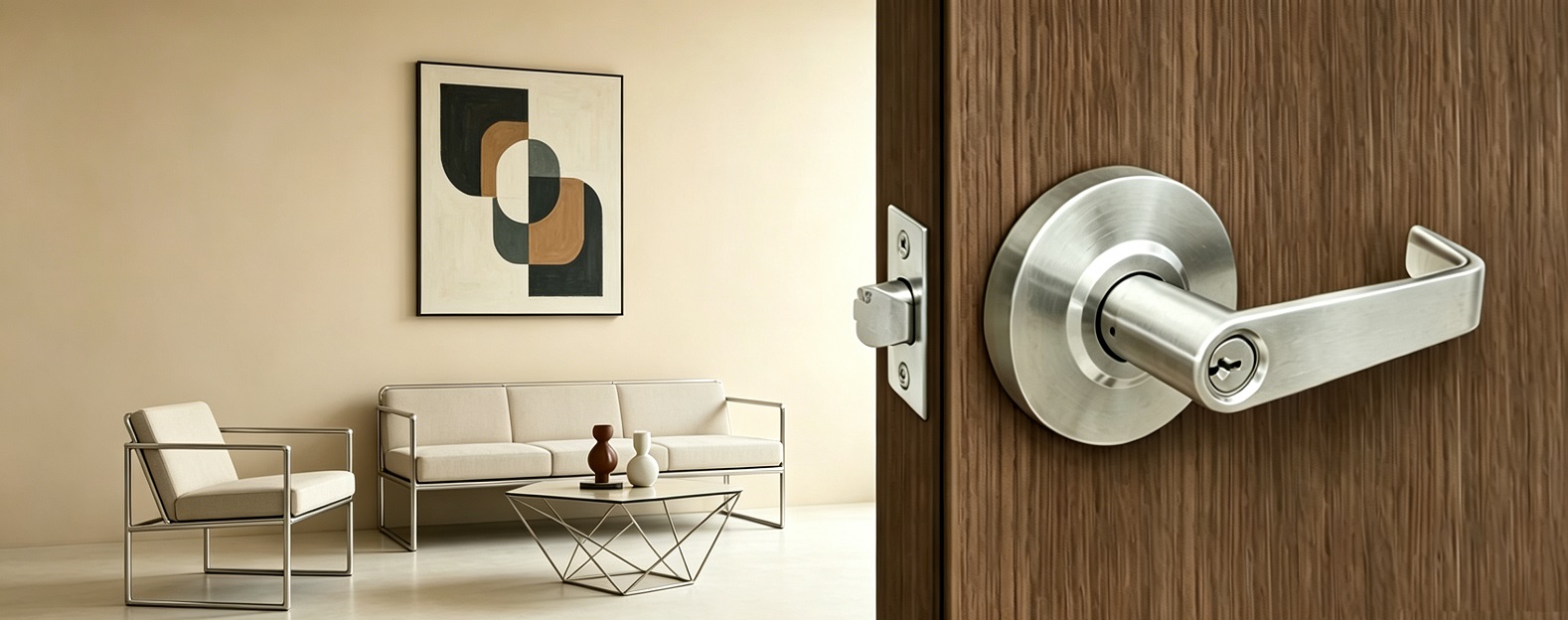
For example, commercial lever locks and door hardware are often tested according to industry standards to ensure reliable operation after repeated cycles. Wingstec offers commercial door hardware solutions including ANSI grade lock products designed for different project requirements. (Wingstec)
Commercial buildings usually require stronger security systems.
Common solutions include:
Mortise locks
Heavy-duty lever locks
Door closers
Security hinges
Access control compatible hardware
These products help improve:
Door protection
User safety
Access management
Residential door hardware focuses more on comfort, design, and practical daily use.
Common applications include:
Bedrooms
Bathrooms
Apartments
Private homes
Residential projects often consider:
Interior style
Color matching
Handle shape
Surface finish
Popular finishes include:
Satin nickel
Matte black
Chrome
Stainless steel finish
Residential hardware is usually designed for simpler installation.
Advantages include:
Standard installation methods
Easy replacement
Lower maintenance requirements
Material selection directly affects product performance.
| Material | Commercial Application | Residential Application |
|---|---|---|
| Stainless steel | Excellent | Excellent |
| Brass | Excellent | Good |
| Zinc alloy | Good | Excellent |
| Aluminum alloy | Good | Good |
Stainless steel is widely used in commercial projects because it provides strong corrosion resistance and durability. Zinc alloy is often selected for residential applications because it supports flexible designs and cost control.
A reliable architectural hardware manufacturer needs strict control throughout production.
The typical manufacturing process includes:
Raw material inspection
Cutting and forming
CNC machining
Surface polishing
Surface treatment
Component assembly
Function testing
Final quality inspection
Commercial door hardware requires additional attention to:
Strength testing
Cycle testing
Load performance
Lock mechanism accuracy
Residential hardware focuses more on:
Appearance quality
Installation compatibility
User comfort
Hardware quality depends on every production stage.
| Inspection Item | Purpose |
|---|---|
| Material testing | Confirm material standards |
| Dimension inspection | Ensure installation accuracy |
| Surface inspection | Maintain appearance |
| Strength testing | Verify durability |
| Functional testing | Ensure smooth operation |
Wingstec applies quality control from material selection to finished product inspection to maintain consistent product performance for different markets. (Wingstec)
The price difference is mainly influenced by material, structure, testing requirements, and service life.
| Cost Factor | Commercial Hardware | Residential Hardware |
|---|---|---|
| Initial cost | Higher | Lower |
| Service life | Longer | Standard |
| Testing requirement | Higher | Moderate |
| Maintenance cost | Lower over time | Moderate |
| Customization | More options | Common options |
Although commercial hardware usually requires higher initial investment, its longer service life can reduce replacement and maintenance costs in high-use buildings.
Choosing an architectural hardware supplier is not only about product availability. Manufacturing capability directly affects:
Product consistency
Delivery stability
Customization ability
Quality control
A professional manufacturer can provide:
Material recommendations
Product development
Surface finishing options
Customized packaging
OEM and ODM services
Wingstec has developed complete architectural hardware solutions covering doors, windows, glass systems, furniture, showers, and washroom applications. (Wingstec)
Customized hardware development usually includes:
Project requirement analysis
Design confirmation
Material selection
Prototype production
Sample testing
Mass production
Quality inspection
Customization options include:
Handle design
Lock structure
Surface treatment
Logo marking
Packaging solutions
Before selecting door hardware, consider:
| Evaluation Item | Key Question |
|---|---|
| Building type | Commercial or residential? |
| Traffic level | Low or high frequency? |
| Security requirement | Standard or heavy duty? |
| Material choice | Stainless steel or alloy? |
| Installation system | Existing or new project? |
| Customization | OEM requirement needed? |
International architectural projects usually require suppliers to provide:
Product specifications
Quality documents
Installation instructions
Packaging standards
Technical support
Reliable manufacturing systems help ensure consistent quality across different markets.
Commercial door hardware is more suitable for:
Hotels
Office buildings
Schools
Hospitals
High-traffic entrances
Residential door hardware is more suitable for:
Homes
Apartments
Interior doors
Private spaces
The best solution depends on usage frequency, security requirements, design expectations, and project budget.
For architectural projects requiring reliable hardware solutions, Wingstec provides professional manufacturing support with OEM/ODM capability, strict quality management, and customized production services. Through controlled manufacturing processes and flexible solutions, Wingstec helps global projects achieve durable and functional door hardware systems.