erick@spiewakgroup.com
0750-3668626
+86-13428282793


Modern buildings require Door Hardware that balances usability, durability, safety, and design. Among the most common choices, lever handles and door knobs remain two widely used solutions for residential, commercial, and architectural projects.
Although both products perform the basic function of opening and closing doors, their structures, operating methods, installation requirements, and application scenarios are different. Selecting the right door hardware can influence user experience, maintenance cost, and long-term building performance.
As a professional architectural hardware manufacturer, Wingstec provides complete door hardware solutions including door handles, locks, hinges, glass hardware, and customized hardware products. With manufacturing experience since 2005, around 4,000㎡ production facilities, multiple production lines, and OEM/ODM capabilities, Wingstec supports customized architectural hardware projects worldwide. (Wingstec)
The main difference between lever handles and door knobs is the operating method.
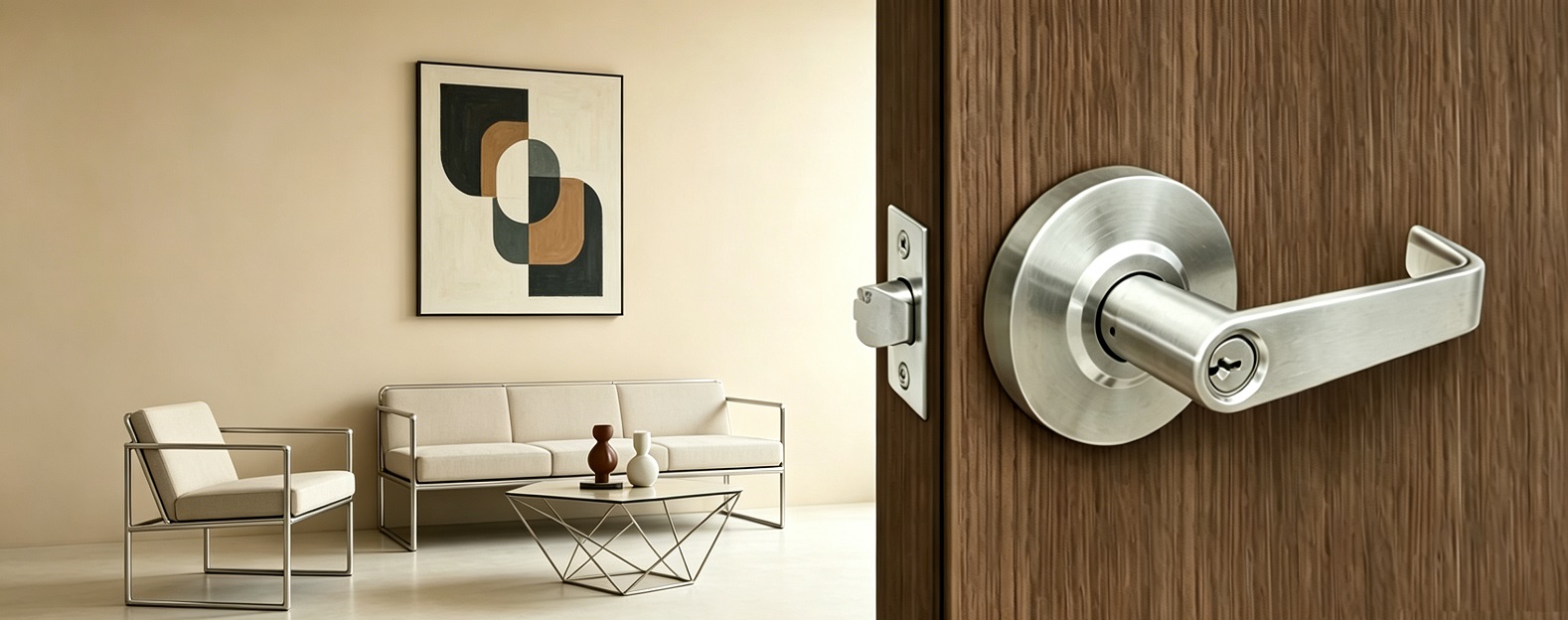
A lever handle uses a horizontal handle that is pushed downward to operate the latch mechanism. It requires less gripping force and provides easier access.
A door knob requires users to rotate a round knob to open the door. It has a traditional appearance and is commonly used in many residential applications.
Door handles are not only functional components but also important elements of architectural design, affecting accessibility, appearance, and daily operation.
| Comparison | Lever Handle | Door Knob |
|---|---|---|
| Operation method | Push down lever | Rotate knob |
| User convenience | Easier operation | Requires gripping and twisting |
| Accessibility | Better for public buildings | More limited |
| Design style | Modern and commercial | Classic and traditional |
| Installation | Compatible with many lock systems | Simple structure |
| Application | Commercial and residential | Mainly residential |
Lever handles have become increasingly popular in modern architectural projects because of their convenience and ergonomic advantages.
The operation process is simple:
User pushes the lever downward
Internal spindle rotates
Latch retracts
Door opens smoothly
Lever handles are easier to operate because they do not require strong gripping or twisting movements.
They are commonly selected for:
Office buildings
Hotels
Hospitals
Schools
Public facilities
Many commercial buildings prefer lever-style hardware because it provides easier access for different user groups.
Lever handles provide:
Clean architectural appearance
Multiple finish options
Better integration with modern interiors
Common finishes include:
Satin stainless steel
Polished stainless steel
Matte black
Chrome finishes
For doors opened hundreds of times per day, lever handles provide better operating efficiency and user comfort.
Door knobs have been used for centuries and remain popular because of their compact structure and classic appearance.
The operating process includes:
User grips the knob
Rotates the knob
Spindle activates the latch
Door opens
Door knobs are suitable for:
Classic interior designs
Residential projects
Decorative applications
Their round shape requires less installation space and provides a simple visual appearance.
For basic residential applications, door knobs can provide a practical and economical solution.
However, door knobs may require more hand strength compared with lever handles, which can affect usability in high-traffic commercial environments.
Different building types have different hardware requirements.
| Building Type | Recommended Solution |
|---|---|
| Office buildings | Lever handles |
| Hotels | Lever handles |
| Hospitals | Lever handles |
| Schools | Lever handles |
| Residential houses | Both options |
| Traditional interior projects | Door knobs |
For modern commercial buildings, lever handles are often preferred because they combine accessibility, durability, and design flexibility.
The performance of door hardware depends heavily on material selection and manufacturing processes.
Common materials include:
Stainless steel
Zinc alloy
Aluminum alloy
Brass
| Material | Advantages |
|---|---|
| Stainless steel | Corrosion resistance and durability |
| Zinc alloy | Flexible design options |
| Aluminum alloy | Lightweight structure |
| Brass | Premium appearance |
Wingstec focuses on material selection, surface treatment, and manufacturing control to ensure stable product performance for different architectural applications. (Wingstec)
A reliable door hardware manufacturer should control every production stage.
The typical manufacturing process includes:
Material preparation
Precision forming
CNC machining
Surface polishing
Electroplating or coating
Assembly
Quality inspection
Packaging
Each step affects:
Surface appearance
Mechanical strength
Corrosion resistance
Service life
Door hardware requires strict quality inspection before shipment.
| Inspection Point | Purpose |
|---|---|
| Material inspection | Confirm raw material quality |
| Dimension checking | Ensure installation accuracy |
| Surface testing | Maintain finish quality |
| Function testing | Verify smooth operation |
| Load testing | Ensure durability |
Wingstec applies quality management procedures throughout production to maintain consistent performance for different project requirements. (Wingstec)
When selecting door hardware, initial cost is only one factor. Long-term performance and maintenance requirements are also important.
| Cost Factor | Lever Handle | Door Knob |
|---|---|---|
| Initial cost | Medium | Lower |
| User convenience | Higher | Medium |
| Commercial suitability | Excellent | Limited |
| Maintenance demand | Low | Low |
| Design flexibility | High | Medium |
For large commercial projects, lever handles often provide better long-term value because of their usability and wider application range.
Architectural hardware projects require more than standard products. A reliable manufacturing partner should provide:
Product customization
Material selection support
Surface finish options
Packaging solutions
Quality control systems
Stable production capacity
Working directly with a manufacturer allows better control over:
Product consistency
Delivery schedule
Custom development
Project coordination
Wingstec provides OEM and ODM architectural hardware solutions, supporting customized designs, project sourcing, and bulk production requirements. (Wingstec)
Customized hardware development usually includes:
Product concept confirmation
Drawing review
Material selection
Prototype development
Sample testing
Mass production
Quality inspection
Customization options include:
Handle shape
Material specification
Surface finish
Packaging design
Functional requirements
Before selecting door hardware, consider:
| Evaluation Item | Key Question |
|---|---|
| Application | Residential or commercial project? |
| Usage frequency | Low or high traffic? |
| Material requirement | Stainless steel or other materials? |
| Design style | Modern or traditional? |
| Quantity | Standard or bulk supply? |
| Customization | OEM requirements needed? |
For international architectural hardware projects, suppliers should provide:
Product specifications
Quality documentation
Packaging standards
Production information
Technical support
These factors help ensure reliable installation and long-term product performance.
A lever handle is usually the better choice for:
Commercial buildings
Public facilities
Modern architectural projects
High-frequency usage environments
A door knob is suitable for:
Traditional interiors
Residential applications
Decorative projects
For modern buildings requiring convenience, accessibility, and long-term durability, lever handles generally provide stronger advantages.
Wingstec delivers professional architectural hardware solutions with manufacturing expertise, OEM/ODM capability, and customized project support. Through reliable production processes and strict quality management, Wingstec helps global projects achieve functional and stylish door hardware solutions.