erick@spiewakgroup.com
0750-3668626
+86-13428282793


China is one of the world’s largest production hubs for Architectural Hardware, supplying door systems, window fittings, glass connectors, furniture hardware, and Bathroom Accessories to global construction markets. Industry trade analysis shows that China’s architectural hardware exports continue to grow steadily, driven by large scale manufacturing capacity, integrated supply chains, and strong OEM and ODM capabilities.
In modern construction projects, architectural hardware is a critical component that directly affects building safety, installation efficiency, and long term maintenance cost.
A reliable supplier in the architectural hardware industry is not only a product provider but also a manufacturing and engineering partner capable of supporting large scale construction projects.
Key capabilities include:
Stable raw material sourcing and quality control
Precision machining and metal forming technology
Surface finishing and corrosion resistance treatment
Mechanical durability and cycle testing systems
OEM and ODM engineering support
Export compliance and certification capability
Engineering benchmarks show that high quality architectural hardware can improve installation efficiency by more than 20 percent in large construction projects by reducing rework and fitting errors.
Leading suppliers in China typically offer a full system of architectural hardware products rather than isolated components.
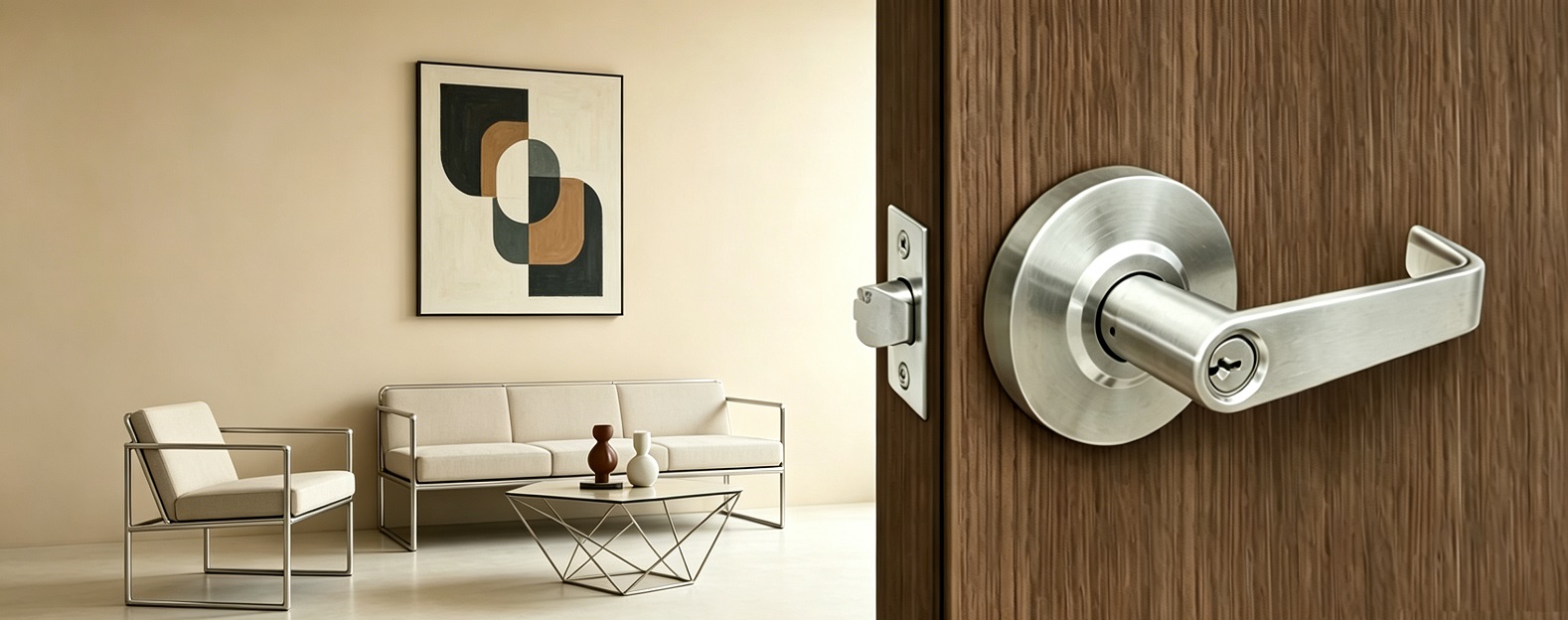
Door Hardware systems including locks, Hinges, and closers
Window hardware systems for residential and commercial buildings
Glass fittings including clamps, connectors, and patch systems
Furniture hardware components such as handles and supports
Bathroom and sanitary accessories
Building safety and control hardware systems
This integrated structure supports hotel, residential, commercial, and infrastructure projects.
A structured manufacturing system ensures consistent quality and durability across architectural hardware products. Key production stages include:
Raw material selection such as stainless steel, zinc alloy, and brass
Die casting or forging of metal components
CNC precision machining for hardware parts
Surface finishing including polishing, brushing, or electroplating
Mechanical assembly of functional systems
Durability and cycle life testing
Final inspection and packaging
Each stage directly affects long term performance and safety in construction applications.
Material selection plays a key role in architectural hardware performance. Stainless steel is widely used for corrosion resistance, zinc alloy is used for structural flexibility and cost efficiency, and brass is used for internal mechanical stability in locking systems.
Engineering data shows that stainless steel components can improve corrosion resistance lifespan by more than 40 percent in humid or coastal environments compared with standard coated metals.
A manufacturer vs trader comparison is essential in architectural hardware procurement. A manufacturer controls material sourcing, production processes, machining accuracy, surface treatment, and durability testing. This ensures consistent quality across large scale construction projects.
A trader relies on external suppliers, which may result in inconsistent material quality, limited engineering control, and reduced customization capability for complex project requirements.
Manufacturers provide stronger advantages in:
Engineering precision and structural design control
Material consistency and stability
Surface finishing quality assurance
Long term durability testing systems
Key inspection stages include:
Mechanical strength and load testing
Corrosion resistance testing under humidity conditions
Cycle durability testing for moving components
Dimensional accuracy verification
Surface coating adhesion testing
Long term operational simulation
These checkpoints ensure compliance with international construction standards and export requirements.
| Product Category | Durability Level | Maintenance Requirement | Best Application |
|---|---|---|---|
| Door hardware systems | Very high | Medium | Hotels and commercial buildings |
| Window hardware systems | High | Low | Residential and office buildings |
| Glass fittings | High | Medium | Commercial glass architecture |
| Furniture hardware | Medium | Low | Interior furniture systems |
For international procurement, key sourcing factors include material grade, mechanical durability, surface finishing quality, cycle life performance, certification compliance, and production scalability. A structured OEM and ODM process includes design validation, sample testing, mass production, quality inspection, and logistics coordination.
Wingstec operates as a professional architectural hardware manufacturer and exporter specializing in door hardware, window hardware, glass fittings, furniture hardware, and bathroom accessories. Its engineering capability ensures stable production quality, scalable supply capacity, and consistent performance across global construction projects.
When selecting architectural hardware suppliers, procurement teams typically evaluate:
Material durability and corrosion resistance
Mechanical performance and cycle life
Installation compatibility with building systems
Surface finishing consistency
Safety and certification compliance
OEM customization capability for project requirements
Global construction and real estate development increasingly prioritize integrated hardware systems that combine durability, safety, and installation efficiency.