erick@spiewakgroup.com
0750-3668626
+86-13428282793


China has become one of the most important global production bases for architectural hardware, supplying door locks, hinges, handles, and complete door control systems for residential, commercial, and industrial construction projects. Industry trade data shows that China accounts for a significant share of global metal hardware exports, driven by large scale manufacturing capability, cost efficiency, and integrated supply chain systems.
Door Hardware quality directly impacts building safety, operational durability, and long term maintenance cost, making supplier selection a critical decision for procurement teams.
A strong door hardware manufacturer is not only a production facility but also an engineering driven organization capable of controlling material selection, machining precision, surface treatment, and lifecycle testing.
Key capabilities include:
Stable raw material sourcing
Precision metal machining and casting
Consistent surface finishing quality
Mechanical durability testing systems
OEM and ODM engineering support
Export compliance and certification readiness
Engineering benchmarks show that high quality commercial door hardware can withstand more than 300,000 to 500,000 opening and closing cycles under standardized testing conditions.
Leading manufacturers in China typically cover a full architectural hardware system rather than single product lines.
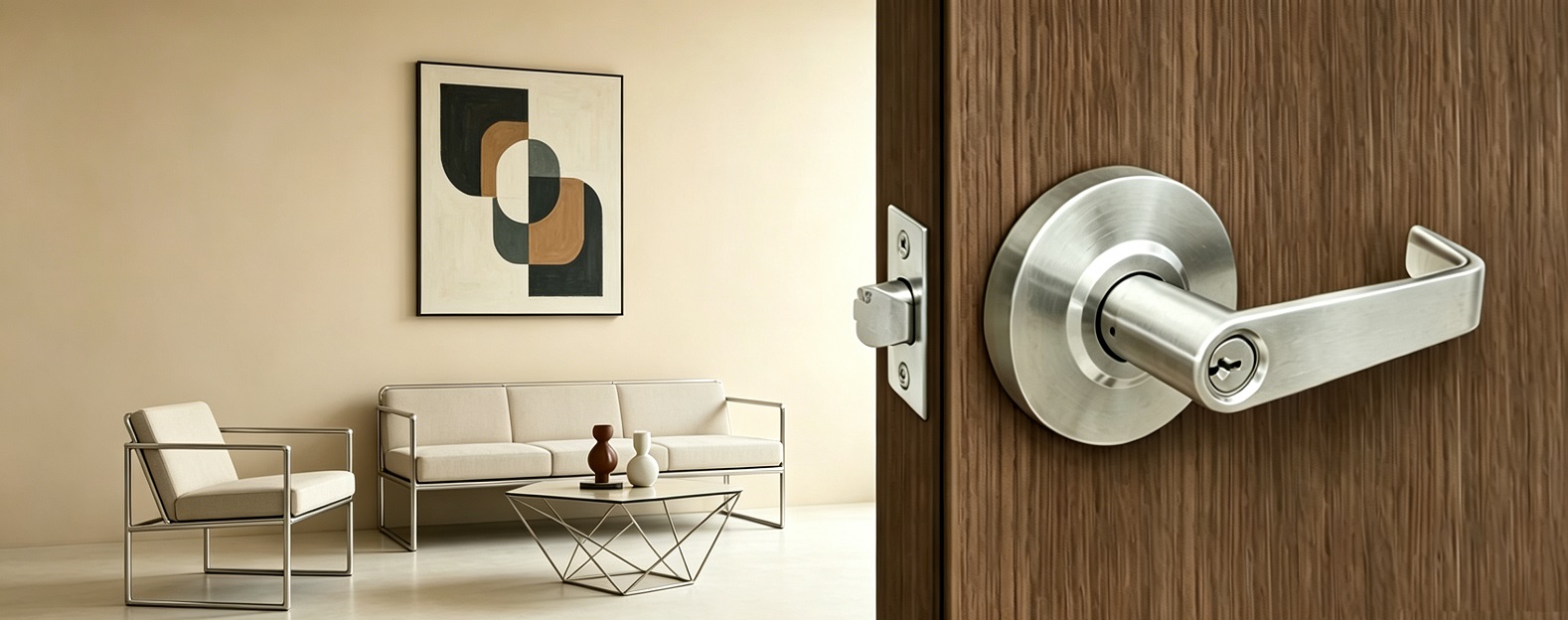
Door lock systems including lever locks, mortise locks, and deadbolts
Hinges including stainless steel, concealed, and heavy duty hinges
Door closers and floor springs
Handles and pull handles
Glass door fittings and patch systems
Window hardware components
Bathroom and interior accessories
This integrated product structure supports large scale construction and renovation projects.
A structured manufacturing system ensures durability and precision in door hardware production. Key production stages include:
Raw material selection and alloy composition control
Die casting or forging of metal components
CNC machining for high precision parts
Surface finishing such as polishing, brushing, or electroplating
Mechanical assembly of locking and hinge systems
Cycle testing for durability and performance stability
Final inspection and packaging
Each stage directly influences long term safety and performance in building applications.
Common materials used in door hardware manufacturing include stainless steel, zinc alloy, and brass. Stainless steel is widely used for corrosion resistance, zinc alloy for structural flexibility, and brass for internal locking mechanisms due to its mechanical stability.
Material testing data shows that stainless steel hardware systems can improve corrosion resistance lifespan by more than 40 percent in high humidity or coastal environments compared with standard coated metal products.
A manufacturer vs trader comparison is essential in architectural hardware sourcing. A manufacturer controls production from raw material processing to final testing, ensuring consistent quality and technical stability.
A trader relies on external supply chains, which may lead to variations in material quality, inconsistent mechanical performance, and limited customization capability for engineering projects.
Manufacturers provide better control over:
Structural design and engineering accuracy
Material grade consistency
Surface treatment quality
Long term durability testing
Key inspection stages include:
Mechanical cycle life testing
Corrosion resistance testing under humidity conditions
Locking mechanism stability verification
Surface coating adhesion testing
Dimensional accuracy measurement
Long term operation simulation
These checkpoints ensure compliance with international construction standards and export requirements.
| Product Type | Durability Level | Maintenance Requirement | Best Application |
|---|---|---|---|
| Standard zinc alloy locks | Medium | Medium | Residential housing |
| Stainless steel door locks | Very high | Low | Hotels and commercial buildings |
| Heavy duty hinges | High to very high | Low | Industrial and public buildings |
| Glass door hardware systems | High | Medium | Office and retail spaces |
For international procurement, key sourcing factors include material grade, mechanical strength, cycle performance, surface finishing quality, certification compliance, and production scalability. A structured OEM and ODM process includes design validation, prototype development, sample testing, mass production, quality inspection, and logistics coordination.
Wingstec operates as a professional architectural hardware manufacturer and exporter specializing in door hardware, window hardware, glass fittings, furniture hardware, and bathroom accessories. Its engineering capability ensures stable production quality, scalable supply capacity, and consistent performance across global construction projects.
When selecting door hardware manufacturers, procurement teams typically evaluate:
Material durability and corrosion resistance
Mechanical cycle life performance
Surface finishing consistency
Installation compatibility with building systems
Safety and certification compliance
OEM customization capability for project branding
Global construction and real estate projects increasingly demand integrated hardware systems that combine durability, safety, and installation efficiency.