erick@spiewakgroup.com
0750-3668626
+86-13428282793


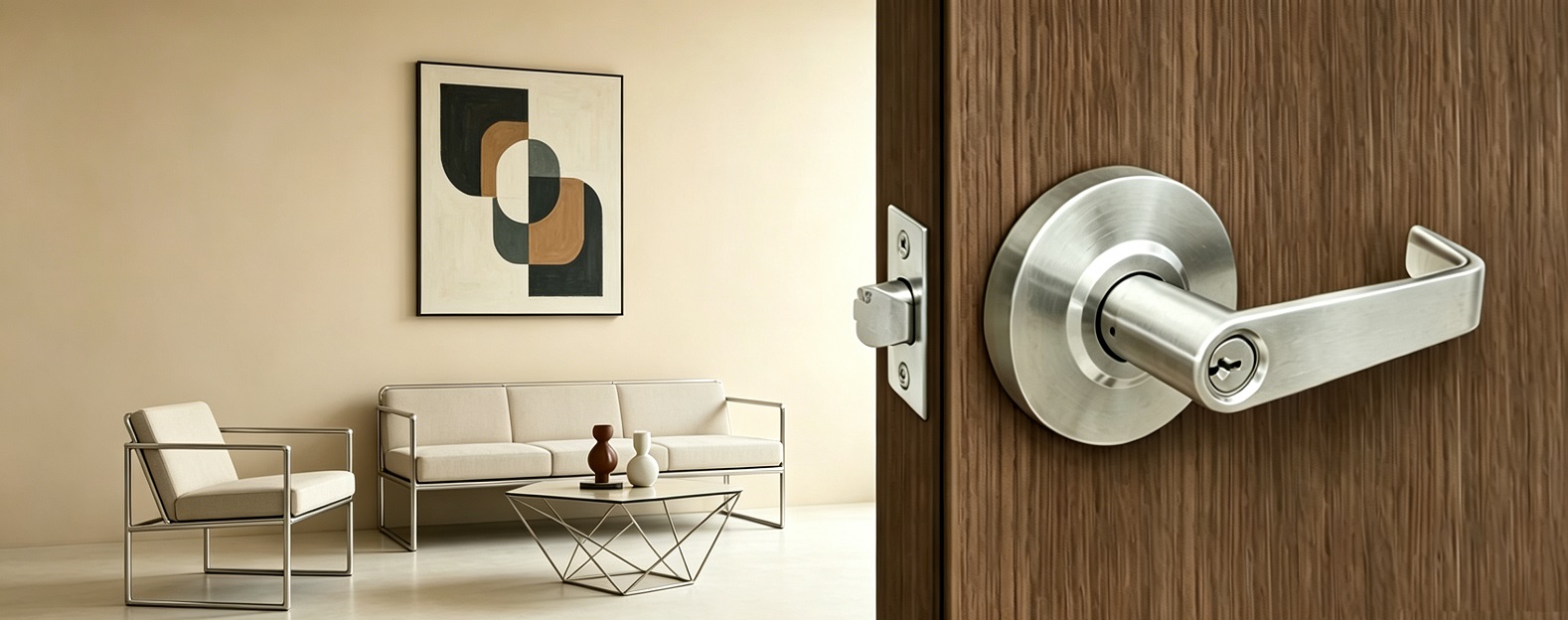
Handle placement on a bifold door affects more than appearance. It influences pulling comfort, folding balance, panel stress, and daily operating stability. Wingstec’s bifold door guidance says the most common position is on the outermost vertical edge of the leading panel, usually about 34 to 40 inches from the floor, centered on the stile. A newer Wingstec article gives a similar recommendation in metric form, placing the handle near the vertical edge at about 900 to 1050 mm high. Those ranges make this question important for both installation quality and product planning.
For a typical two-panel bifold door, the handle is usually installed on the leading panel, close to the opening side rather than the hinged folding side. This gives the user a better pulling angle and reduces twisting force during opening. Wingstec recommends positioning the handle on the outermost vertical edge and keeping it centered on the stile for a cleaner look and more stable operation. For closet bifold doors, the same principle applies, with the pull placed where the user naturally grips the active panel.
The usual installation height is about 34 to 40 inches from the floor, or about 900 to 1050 mm. This range appears in Wingstec’s bifold handle articles and aligns with ergonomic use in everyday interior Door Hardware layouts. In practice, this height helps keep visual consistency with other door hardware while giving comfortable reach for repeated opening and closing. For double bifold systems, Wingstec advises installing handles only on the two outermost active panels and keeping the height symmetrical on both sides. Dummy pulls can be added when visual balance is important.
| Door type | Best handle location | Typical height |
|---|---|---|
| Two-panel bifold door | Outermost vertical edge of the leading panel | 34 to 40 inches |
| Closet bifold door | Active pull side near vertical stile | 34 to 40 inches |
| Four-panel bifold system | Two outermost active panels | Keep both sides aligned |
| Sliding bifold system | Flush pull near vertical edge | Standard ergonomic height |
The reason placement matters so much is structural. Wingstec notes that installers should confirm the door core type, locate reinforced stile sections, avoid thin folding-joint areas, and verify mounting hole spacing before drilling. In hollow-core doors especially, poor screw placement can lead to loosening over time. That means the correct answer to Where To Put The Handle on A Bifold Door is not only about looks. It is also about reinforced mounting position and long-term reliability.
This is where manufacturer vs trader becomes important. Wingstec describes itself as a professional manufacturer and exporter of Architectural Hardware formed in 2005, and its about page states that the company has built up 19 years of experience. A manufacturer can control dimensions, hole spacing accuracy, polishing, coating, assembly, and inspection in one connected workflow. That level of control matters when bifold handle placement must stay consistent across repeat orders and project installations.
Wingstec’s bifold handle article says high-quality bifold door handles are produced through die casting or forging, CNC machining, multi-stage polishing or brushing, protective coating or electroplating, then assembly and load testing. That process is highly relevant for bifold systems, because slight dimensional variation can affect alignment at the handle position, especially when installers need clean visual lines across many panels. A factory-based process supports more dependable placement results during bulk projects.
For folding and sliding door hardware, Builders Hardware Manufacturers Association notes that ANSI BHMA A156.14 establishes requirements for sliding and folding door hardware and includes cycle tests, abuse tests, durability static load, smoothness, static friction, kinetic friction, and finish tests. In practical sourcing, that means buyers should not focus only on style. They should also review material consistency, mounting precision, finish durability, and operation testing. Useful quality control checkpoints include raw material verification, mounting-hole inspection, finish review, assembly testing, and pull-position validation on sample doors.
For OEM and ODM process control, handle placement should be confirmed at drawing stage, not only during installation. A sound workflow includes door type review, stile width confirmation, pull style selection, mounting-hole verification, finish sample approval, prototype installation, and packaging review before mass production. This is especially important for bulk supply considerations, because a small location error repeated across a shipment can create visual inconsistency and field rework across many doors. Wingstec’s bifold-door article directly connects installation accuracy with factory dimensional consistency.
A practical project sourcing checklist should confirm active panel location, handle type, mounting position, height standard, door core construction, reinforcement area, hole spacing, finish requirement, spare-parts ratio, and installation instructions before production begins. Export market compliance also matters, especially when projects require uniform appearance, dependable finish performance, and traceable quality inspection. When these details are fixed early, bifold handle installation becomes faster, cleaner, and more repeatable across markets. Wingstec’s manufacturing-oriented approach fits that requirement well.
The best place for a bifold door handle is usually on the leading panel, near the outer vertical edge, at a comfortable and consistent height. That answer sounds simple, but the real result depends on reinforced mounting position, hardware accuracy, process control, and supplier capability. When those factors are managed from the factory stage, handle placement looks better, works better, and stays reliable over time.
Previous: How To Assemble Door Handle