


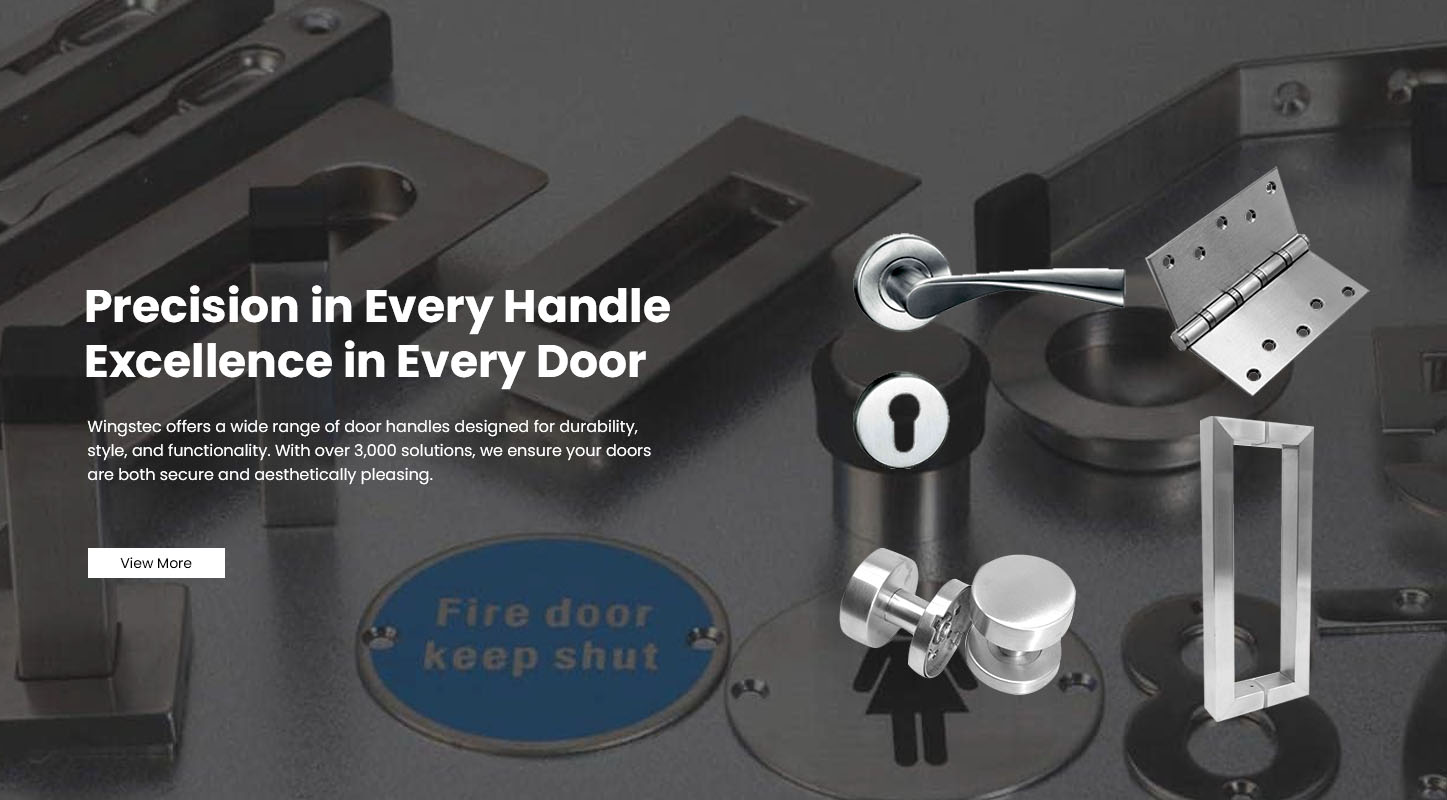
A door handle that won’t turn is usually a sign of internal mechanical failure, misalignment, or material wear. While the issue can often be fixed on-site, it also reflects deeper factors such as manufacturing precision, component durability, and assembly quality.
From a professional architectural hardware manufacturing perspective, resolving this issue requires both practical repair steps and an understanding of how the handle system is engineered.
Table of Contents
- Common Causes of a Door Handle That Won’t Turn
- Step-by-Step Fixing Method
- Manufacturer vs Trader: Impact on Mechanical Reliability
- OEM / ODM Process for Reliable Door Handle Systems
- Manufacturing Process Overview
- Quality Control Checkpoints
- Material Standards Used
- Bulk Supply Considerations
- Project Sourcing Checklist
- Export Market Compliance
- Conclusion
Common Causes of a Door Handle That Won’t Turn
Seized or Worn Latch Mechanism
The latch inside the Lock Body may become stuck due to wear, lack of lubrication, or internal deformation. This prevents the spindle from driving the latch.
Spindle Misalignment or Damage
If the spindle is bent or not properly aligned with the latch, rotational force cannot be transferred effectively.
Internal Spring Failure
A broken or weakened return spring can cause the handle to lock in place or fail to move.
Debris or Corrosion Inside the Mechanism
Dust, metal particles, or corrosion can block internal movement, especially in humid environments.
Step-by-Step Fixing Method
Step 1: Check External Obstructions
Ensure the door is not under pressure from misalignment or swelling. Structural stress can prevent smooth handle operation.
Step 2: Remove the Handle
Disassemble the handle to access internal components. For concealed designs, locate the set screw or release mechanism.
Step 3: Inspect the Spindle
Check for bending, wear, or incorrect length. Replace if necessary to restore proper engagement with the latch.
Step 4: Examine the Latch Mechanism
Press the latch manually. If it does not retract smoothly, the internal lock body may need replacement.
Step 5: Lubricate Internal Parts
Apply suitable lubricant to moving components to reduce friction and restore motion.
Step 6: Reassemble and Test
Reinstall the handle and ensure smooth rotation and latch operation.
Manufacturer vs Trader: Impact on Mechanical Reliability
Handle failure often reflects supplier capability.
| Criteria | Manufacturer | Trader |
|---|---|---|
| Internal Mechanism Design | Engineered and tested | Generic sourcing |
| Spindle Precision | CNC-machined | Variable |
| Spring Durability | High-cycle tested | Unverified |
| Assembly Accuracy | Controlled process | Inconsistent |
Factory-based suppliers ensure consistent mechanical performance and reduced failure rates.
OEM / ODM Process for Reliable Door Handle Systems
Professional manufacturers implement structured development to prevent such issues:
Engineering Design
Torque and load analysis
Spring tension calibration
Spindle-latch compatibility optimization
Prototype Testing
Cycle testing exceeding 200,000 operations
Stress testing under repeated use
Alignment and tolerance validation
Custom Development
Handle geometry and ergonomic optimization
Internal mechanism adaptation for different markets
Finish and branding customization
Mass Production
Precision machining and forming
Controlled assembly with calibrated torque
Batch-level quality verification
This ensures stable operation in both residential and high-frequency commercial environments.
Manufacturing Process Overview
High-quality Door Handles are produced through:
Material forming using stainless steel, zinc alloy, or aluminum
CNC machining for internal components
Surface finishing such as brushed or coated treatments
Assembly of mechanical systems
Final inspection and functional testing
Wingstec integrates production and engineering to deliver consistent hardware solutions across global markets.
Quality Control Checkpoints
To prevent handle malfunction, manufacturers implement:
Component Inspection
Spindle dimensional accuracy
Spring elasticity testing
Assembly Verification
Alignment of handle and latch
Smooth rotation testing
Final Testing
Cycle durability testing
Load and torque testing
Surface finish inspection
These checkpoints ensure long-term reliability across bulk production.
Material Standards Used
Material quality directly affects performance:
304 Stainless Steel: corrosion resistance and strength
Zinc Alloy: design flexibility and structural stability
Aluminum Alloy: lightweight with precise machining
Hardened Steel Springs: long-lasting elasticity
Inferior materials often lead to deformation and mechanical failure.
Bulk Supply Considerations
For large-scale procurement:
Consistency in internal mechanism performance
Stable material sourcing
Uniform assembly standards
Reliable production capacity
Manufacturers with integrated production lines provide better control over these factors.
Project Sourcing Checklist
When selecting door handles:
Verify cycle testing standards
Check spindle and latch compatibility
Confirm material specifications
Evaluate supplier engineering capability
Request technical drawings and samples
This reduces maintenance issues and ensures smooth installation.
Export Market Compliance
Export-oriented manufacturers align with international standards:
Mechanical durability requirements
Corrosion resistance standards
Dimensional compatibility for global applications
Compliance ensures reliable performance in various environments.
Conclusion
A door handle that won’t turn is typically caused by internal mechanical issues such as latch failure, spindle misalignment, or component wear. While repair steps can resolve the immediate problem, long-term reliability depends on engineering precision, material quality, and manufacturing control.
For project buyers and bulk sourcing, choosing a manufacturer with strong OEM capability and strict quality assurance ensures consistent performance, reduced maintenance, and dependable operation across all installations.