


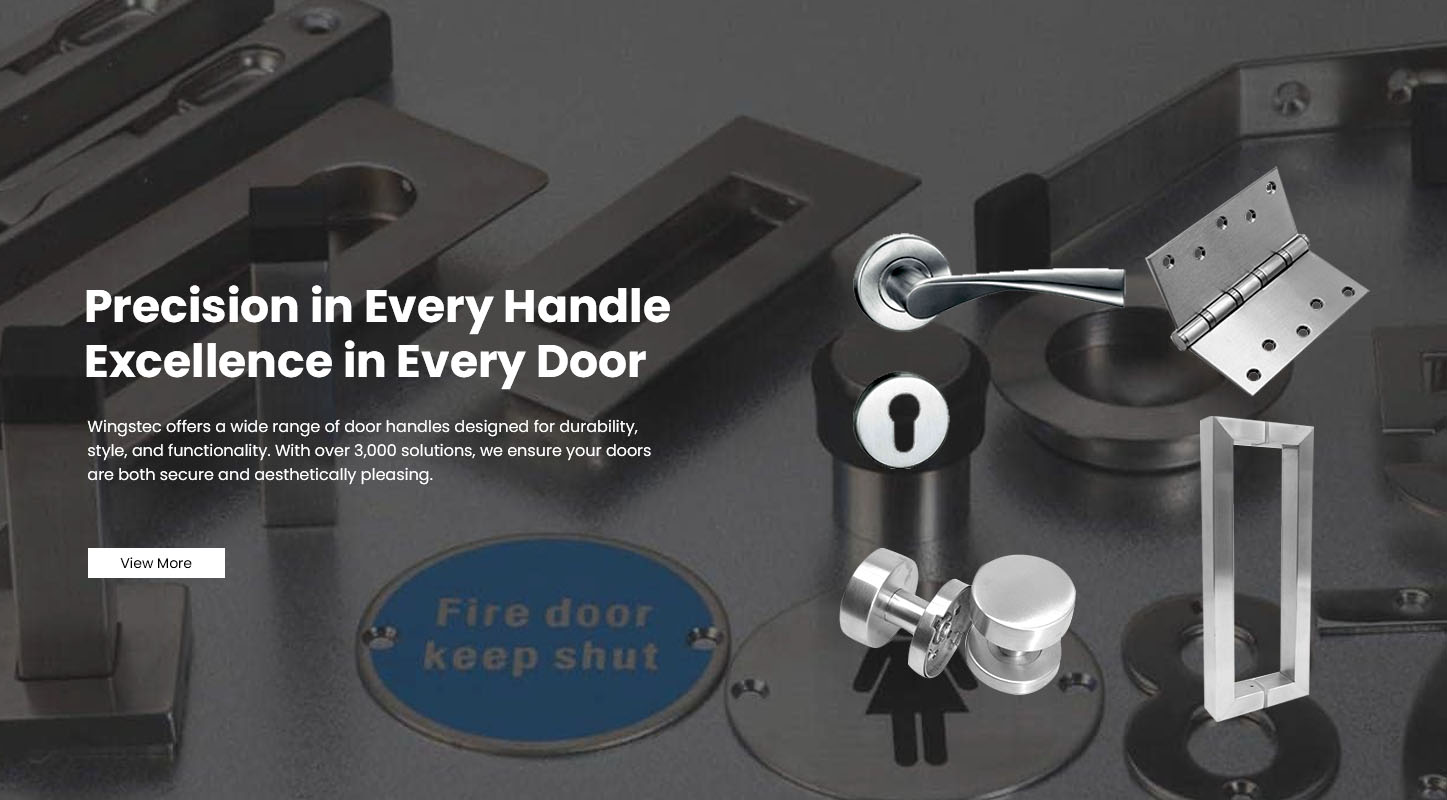
A door handle may appear simple on the surface, but its operation relies on a precise combination of mechanical components, material strength, and manufacturing accuracy. Understanding how a door handle works helps not only in maintenance but also in evaluating product quality for large-scale procurement.
As a professional architectural hardware manufacturer with extensive experience in door and furniture hardware systems, Wingstec integrates design, engineering, and production to deliver reliable handle solutions for residential and commercial applications.
Table of Contents
- Basic Working Principle of a Door Handle
- Key Components and Their Functions
- Manufacturer vs Trader: Impact on Mechanical Performance
- OEM / ODM Process for Door Handle Systems
- Manufacturing Process Overview
- Quality Control Checkpoints
- Material Standards Used
- Bulk Supply Considerations
- Project Sourcing Checklist
- Export Market Compliance
- Conclusion
Basic Working Principle of a Door Handle
A standard door handle operates through a mechanical linkage system that converts rotational motion into linear movement.
Core Function Flow
The user rotates or presses the handle
The spindle connected to the handle turns simultaneously
The spindle drives the latch mechanism inside the Lock Body
The latch retracts, allowing the door to open
Releasing the handle returns the latch to its original position via a spring system
This system must maintain smooth operation across thousands of cycles without failure.
Key Components and Their Functions
Handle Lever or Knob
The external interface used by the user. Its design affects ergonomics and force transmission.
Spindle
A square or cylindrical metal shaft connecting both sides of the handle. It transfers rotational force to the latch mechanism.
Latch Mechanism
The internal component that locks and releases the door. It moves horizontally when activated.
Return Spring
Ensures the handle returns to its original position after use. High-quality springs maintain elasticity over long-term operation.
Backplate or Rosette
Provides structural support and secures the handle to the door surface.
Manufacturer vs Trader: Impact on Mechanical Performance
The reliability of a door handle depends heavily on engineering and production control.
| Criteria | Manufacturer | Trader |
|---|---|---|
| Internal Mechanism Design | Engineered and tested | Standard sourcing |
| Spring Durability | High-cycle tested | Unverified |
| Spindle Precision | CNC-machined | Variable |
| Long-Term Performance | Stable | Inconsistent |
Factory-based production ensures smooth operation and consistent quality across batches.
OEM / ODM Process for Door Handle Systems
Professional manufacturers follow structured development to ensure performance and compatibility:
Design Engineering
Load analysis for handle force
Spring tension calibration
Compatibility with different lock bodies
Prototype Testing
Cycle testing exceeding 200,000 operations
Torque resistance testing
Alignment and stability validation
Custom Development
Handle shape and finish customization
Spindle size and latch compatibility adjustment
Branding and packaging design
Mass Production
Precision machining and forming
Controlled assembly processes
Batch consistency verification
This process ensures reliable performance in both residential and high-frequency commercial use.
Manufacturing Process Overview
High-quality Door Handles are produced through:
Material forming using stainless steel, zinc alloy, or aluminum
CNC machining for internal components
Surface finishing such as brushed, polished, or coated treatments
Assembly of mechanical parts with calibrated torque
Final inspection and functional testing
Wingstec offers a wide range of architectural hardware solutions with integrated production capabilities and consistent engineering standards.
Quality Control Checkpoints
To ensure smooth operation and durability, manufacturers implement:
Component Inspection
Dimensional accuracy of spindle and latch
Spring elasticity testing
Assembly Verification
Alignment of internal components
Handle return performance
Final Testing
Cycle testing for durability
Load and torque testing
Surface finish inspection
These checkpoints guarantee consistent performance across bulk production.
Material Standards Used
Material selection directly affects durability and user experience:
304 Stainless Steel: corrosion resistance and structural strength
Zinc Alloy: flexibility in design and cost efficiency
Aluminum Alloy: lightweight and stable machining properties
Hardened Steel Springs: long-lasting elasticity
High-quality materials ensure smooth operation and resistance to wear over time.
Bulk Supply Considerations
For large-scale procurement:
Consistency in internal mechanism performance
Uniform finish and appearance across batches
Stable production capacity
Reliable delivery timelines
Manufacturers with integrated production lines provide better control over these factors.
Project Sourcing Checklist
When selecting door handles for projects:
Verify cycle testing standards
Check compatibility with lock systems
Confirm material grade and finish
Evaluate supplier engineering capability
Request technical drawings and samples
This reduces installation issues and long-term maintenance costs.
Export Market Compliance
Export-oriented manufacturers align with international requirements:
Mechanical durability testing standards
Corrosion resistance requirements
Dimensional compatibility for global markets
Compliance ensures reliable performance across different environments and usage scenarios.
Conclusion
A door handle works through a coordinated system of mechanical components that convert user input into latch movement. While the principle is simple, long-term performance depends on precision engineering, material quality, and strict manufacturing control.
For project buyers and bulk sourcing, selecting a manufacturer with strong OEM capability and comprehensive quality assurance ensures smooth operation, durability, and consistent product performance across all installations.