erick@spiewakgroup.com
0750-3668626
+86-13428282793


Handle placement on bifold doors directly affects usability, balance, and long-term durability. Unlike standard hinged doors, bifold doors operate on a pivot-and-track system, meaning handle positioning must consider panel movement, folding clearance, and structural reinforcement points.
Improper placement can cause uneven pulling force, panel misalignment, or premature hardware loosening. From a manufacturing perspective, correct positioning also ensures screw anchoring into reinforced sections of the door panel.
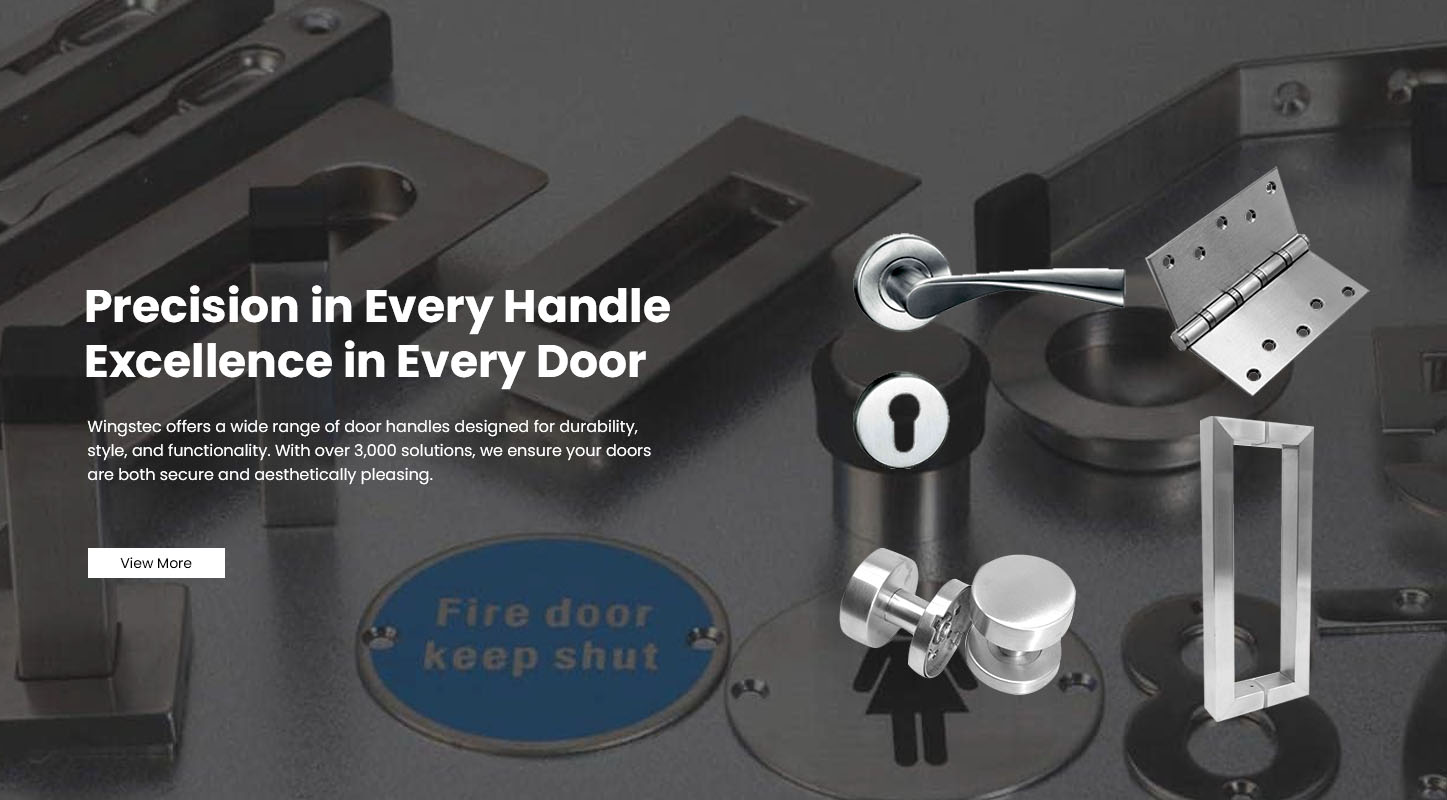
As a professional architectural hardware manufacturer, Wingstec produces bifold Door Handles, flush pulls, lever handles, hinges, sliding systems, and related door accessories with integrated production control, OEM/ODM capability, and export-grade quality systems.
For typical two-panel bifold doors:
Install the handle on the outermost vertical edge of the leading panel.
Position approximately 34 to 40 inches from the floor.
Align centrally along the panel’s stile (vertical frame section).
This height range matches ergonomic standards for comfortable pulling and maintains alignment consistency with other interior Door Hardware.
For closet applications:
Place the handle on the outer vertical edge of each folding section.
Maintain equal height alignment across panels.
Avoid installing near the center joint where panels fold.
Mounting near the folding hinge may interfere with door operation and reduce structural strength.
In four-panel systems:
Install handles on the two outermost panels only.
Position symmetrically for visual balance.
Maintain consistent height across both sides.
If decorative symmetry is required, dummy pulls may be used on non-active panels.
For bifold doors that slide into a pocket:
Install flush pulls near the vertical edge.
Position at standard ergonomic height (34–40 inches).
Ensure recess depth does not weaken panel thickness.
Precision stamping and thickness control during manufacturing prevent surface deformation after installation.
Before installing handles:
Confirm door core type (solid wood, MDF, hollow core).
Locate reinforced stile sections.
Avoid drilling into thin folding joint areas.
Confirm handle mounting hole spacing.
In hollow-core doors, improper screw placement may cause long-term loosening.
High-quality bifold door handles are produced through:
Die casting or forging for structural integrity
CNC machining for mounting hole precision
Multi-stage polishing or brushing
Electroplating or protective coating application
Assembly and load testing
As a factory-based manufacturer, Wingstec maintains dimensional consistency across bulk production to ensure accurate alignment during installation.
When sourcing bifold door handles:
Manufacturer Advantages
Controlled mounting hole spacing
Verified screw anchoring strength
Finish consistency across batches
Customizable dimensions for panel thickness
Stable high-volume production capability
Trader Limitations
Limited oversight of structural reinforcement
Potential variation in mounting alignment
Reduced customization flexibility
Precise manufacturing reduces misalignment risk during installation.
Projects may require custom hardware positioning solutions:
Extended pull lengths for tall panels
Reinforced mounting base design
Finish customization
Flush pull dimension adjustments
Branding integration
A structured OEM/ODM workflow includes prototype validation to ensure compatibility with door thickness and folding mechanisms.
For project procurement:
Confirm panel thickness compatibility
Verify mounting hole specifications
Review corrosion resistance testing data
Ensure consistent finish across batches
Confirm packaging standards for export protection
Uniform installation results are critical in hospitality, residential complexes, and commercial projects.
Professional factories implement:
Dimensional tolerance inspection
Mounting strength verification
Surface adhesion testing
Corrosion resistance evaluation
Final appearance inspection
These measures ensure handles remain secure under repeated pulling force.
Common materials include:
Stainless steel for corrosion resistance
Zinc alloy for casting precision
Solid brass for premium applications
Reinforced steel screws for anchoring strength
Material selection directly influences load-bearing durability.
For international supply:
Surface durability documentation may be required
Corrosion resistance test reports support compliance
Protective packaging prevents transport damage
Complete export documentation ensures smooth customs clearance
Integrated production and inspection systems streamline global distribution.
Handles on bifold doors should be installed on the outer vertical edge of the leading panel at approximately 34 to 40 inches from the floor. Proper placement ensures ergonomic comfort, smooth folding operation, and structural stability.
Behind correct positioning lies careful consideration of panel reinforcement, mounting precision, and material strength. Partnering with a qualified door hardware manufacturer ensures consistent bulk supply capability, customization flexibility, and reliable installation performance for global architectural projects.
Previous: Where To Put Handles on Cabinet Doors