erick@spiewakgroup.com
0750-3668626
+86-13428282793


A dummy door handle is a fixed, non-operational door handle designed purely for decorative or pull purposes. Unlike passage, privacy, or entry handles, a dummy handle does not connect to a latch mechanism or spindle. It does not rotate and does not control a latch bolt. Its primary function is to provide a gripping point for opening or closing a door that already operates on a separate catch system, roller latch, magnetic latch, or ball catch.
Dummy handles are commonly used on:
Closet doors
Pantry doors
French doors
Cabinet-style doors
Decorative double doors where only one side is active
From a structural standpoint, a dummy handle contains fewer internal components, which simplifies installation and reduces mechanical wear points.
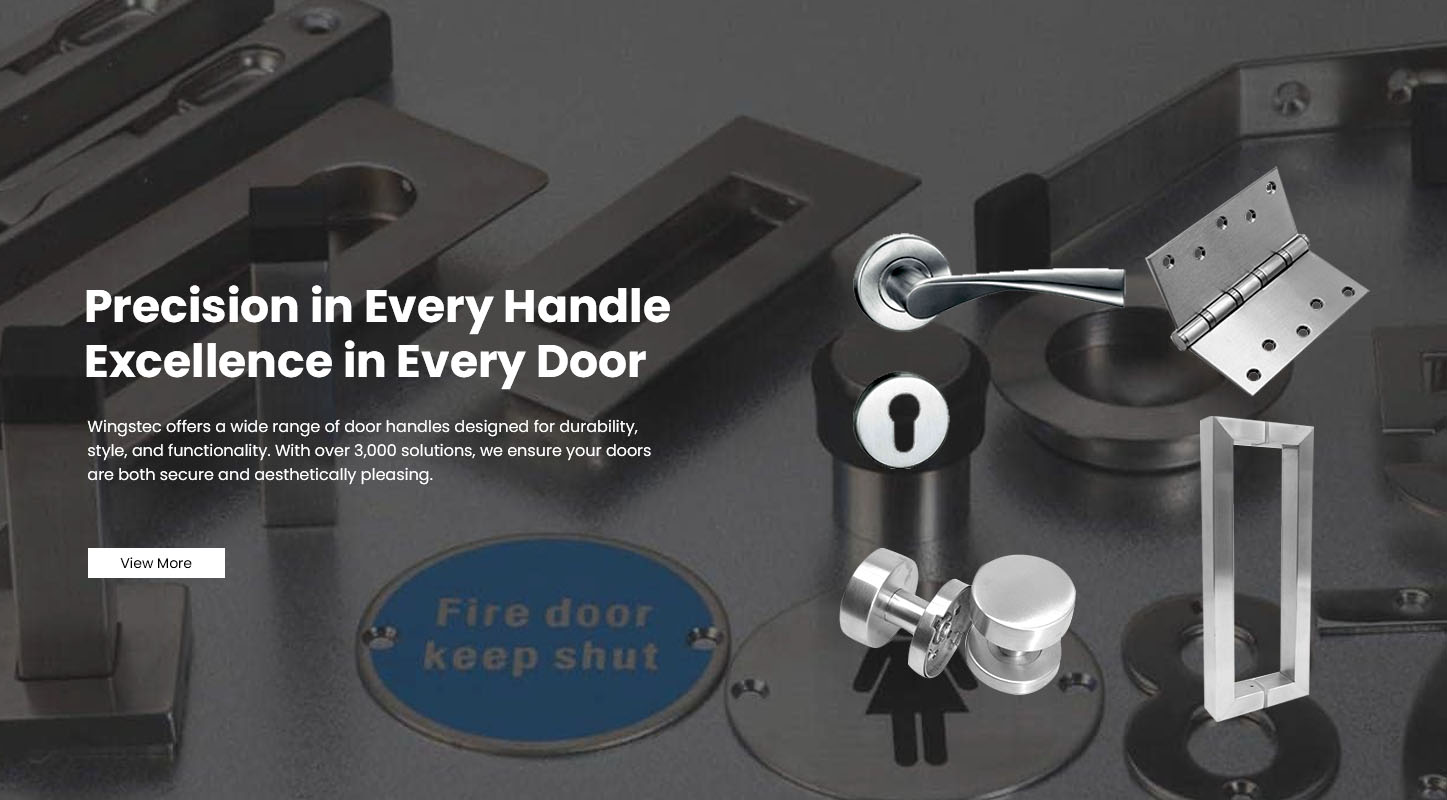
As a professional architectural hardware manufacturer, Wingstec produces dummy handles, passage handles, privacy locksets, entrance systems, hinges, and related accessories with integrated production control, OEM/ODM capability, and export-oriented quality management systems.
Unlike functional locksets, a dummy handle:
Does not include a spindle
Does not contain a latch mechanism
Does not retract any bolt
Does not rotate
It is mounted directly to the door surface using screws and acts as a pull handle only.
In double-door systems, one door may contain a full latch mechanism, while the inactive door uses a dummy handle for symmetry and aesthetic consistency.
Installed on one side of the door only. Common for pantry or closet applications.
Installed on both sides of the door surface but still non-operational. Often used on decorative French doors.
A typical dummy handle set includes:
Fixed lever or knob body
Mounting base or plate
Fixing screws
Decorative rosette
Because there is no internal cam or latch, mechanical complexity is significantly reduced.
Although dummy handles are mechanically simple, structural durability depends on manufacturing quality. Production typically involves:
Die casting or forging for handle body formation
CNC machining for mounting base precision
Surface polishing or brushing
Electroplating or protective coating application
Mounting screw alignment verification
Final surface inspection
As a factory-based manufacturer, Wingstec controls finish consistency and dimensional accuracy across bulk production.
Even though dummy handles lack moving parts, sourcing from a manufacturer provides advantages:
Manufacturer Advantages
Controlled metal thickness
Verified screw anchoring strength
Surface finish consistency
Corrosion resistance testing
Stable high-volume production capability
Trader Limitations
Limited oversight of metal density and casting quality
Potential finish inconsistency between batches
Reduced customization flexibility
Structural rigidity is essential to prevent loosening over time.
Dummy handles are frequently customized for architectural projects. Customization may include:
Lever shape modification
Finish customization
Mounting plate reinforcement
Door thickness compatibility adjustment
Branding or logo integration
A structured OEM/ODM workflow includes sample validation before bulk production to ensure alignment accuracy and finish durability.
For project procurement:
Confirm mounting hole spacing
Verify door thickness compatibility
Review finish durability requirements
Ensure consistent color and texture across batches
Confirm packaging standards for export protection
Uniform visual appearance is particularly important in hospitality and residential developments.
Professional factories implement:
Dimensional tolerance inspection
Surface adhesion testing
Corrosion resistance evaluation
Mounting strength verification
Final appearance inspection
These measures ensure long-term stability and aesthetic consistency.
Common materials include:
Stainless steel for corrosion resistance
Zinc alloy for casting precision
Solid brass for premium applications
Reinforced steel mounting screws
Material selection directly impacts load-bearing capacity and finish durability.
For international supply:
Surface durability documentation may be required
Corrosion resistance test reports support compliance
Protective packaging prevents transit damage
Complete export documentation ensures smooth customs clearance
Integrated production and inspection systems streamline global distribution.
A dummy door handle is a fixed, decorative pull designed without a latch or locking mechanism. While mechanically simple, its structural stability, finish durability, and installation alignment depend on manufacturing precision and material quality.
Partnering with a qualified door hardware manufacturer ensures consistent bulk supply capability, customization flexibility, and long-term aesthetic reliability suitable for global architectural projects.
Previous: Where To Put Handles on Bifold Doors